

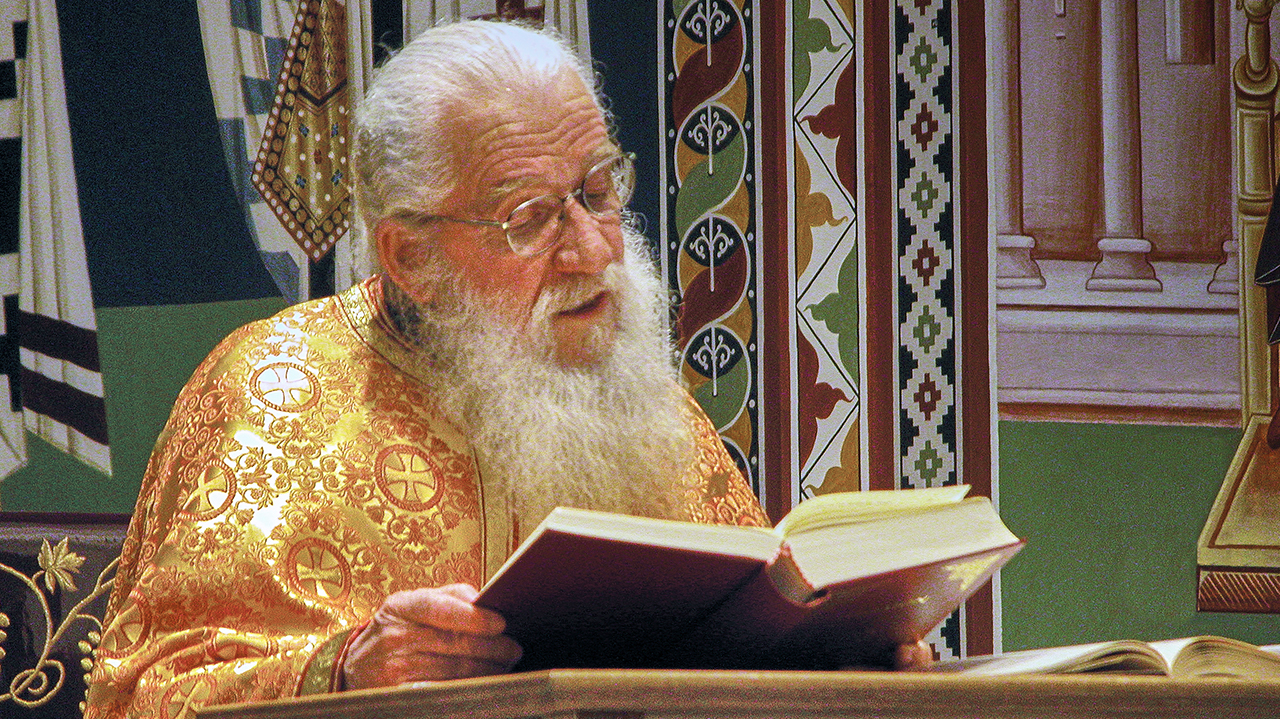
A Brief Biography of Fr. Symeon Kragiopoulos
Childhood Years
Fr. Symeon was born in Ritini in Pieria on March 9th 1926 to simple and pious parents, Ioannis and Eleni. His baptismal name was Konstantinos and he was the second of the six children of the family, two of whom passed away at a young age. He grew up with his older sister Dimitra and two younger brothers, Georgios and Stefanos.
His father was a man of faith who devoted much time to prayer each day. He fought in the war in Asia Minor and afterwards worked as a postman. When he carried the mail by horse to the villages of Katerini, he was accustomed to chanting prayers in a soft and sweet voice. He taught Konstantinos prudence and the Christian faith through prayer and the reading of spiritual books.
Konstantinos’s mother had the natural humility and benevolence of a simple village woman and she taught Konstantinos patience, open-heartedness and her unseen virtues. She influenced him with her patience by remaining calm through the difficult circumstances of life and maintaining serenity despite any affronts to her will. By example, she sowed the seeds of her own rich emotional intelligence in Konstantinos through her ability to maintain a balanced disposition in the midst of crises.
His grandfather, Konstantinos, was a noble man whose life was characterized by courage and purity. Little Konstantinos joyfully helped his grandfather in agricultural chores and, as he himself said, he esteemed and loved his grandfather immensely. The grandfather, in return, respected his grandson’s insightfulness and willingness and taught him to work with zeal and nobility of spirit. This young man, who would become a worker in the spiritual garden, learned to think in a practical way by responding to his grandfather’s teachings in a spirit of discipleship.
The experiences of his childhood years 1926-1938, and in the peaceful village, definitively molded his character. The harmonious family environment, the agricultural labor, the experience caring for the animals, his elementary school years (he was honored as the best student that passed through the school), the paths in the beautiful forests, the relationships with his peers, the stories of the elders, and the traditions and customs of the close-knit society of the village – all these elements cultivated young Konstantinos’s grace-filled heart.
Later in his life, Fr. Symeon used the practical knowledge gleaned from his agricultural labors and childhood experiences in the mountainous village of Ritini to eloquently explain the meaning of the spiritual life. He repeatedly said: “We who have experiences from life in the village better understand the Bible.” Because of that, he would become excited about the Biblical parables concerning rural life which Christ used in the Bible and he explained them in detail to ultimately interpret their deep spiritual message.
He absorbed the folk wisdom of the simple people from the Greek countryside. Therefore, when he grew up, he would reminisce about the simplicity of the elders. He didn’t like pretentious mannerisms and coy behavior. He often emphasized that the villagers despite being illiterate were precise, clear and concise in their speech because these things emanated from their sincere hearts. He remembered many words from the local dialect and was happy to explain them. Because of the preceding Turkish occupation, the pious people in the village where he grew up didn’t know much about the faith. They lived with superstitions and did not have a “tangible” spiritual life, but most of them attended church regularly, fasted properly, prayed their prayers and lived with reverence and piety.
That which most influenced his young soul were the examples of his parents and of the two pious priests of the village, Fr. Dimitrios and Fr. John. Fr. Dimitrios came to their house every week and served the Paraklesis to the Panagia. Every so often he served the Liturgy in a chapel in the village, on which occasions Konstantinos’s whole family was in attendance to receive Holy Communion. His grandmother and later his mother made prosfora every Friday with great piety, as though solemnly participating in a religious ceremony. His father chanted in the Liturgies and the services of Holy Week, and in the home, he studied spiritual texts and prayed every day. He motivated Konstantinos to read spiritual books and taught him easy ways to recognize the eight tones in the ecclesiastic music.
In this way, the pure heart of young Konstantinos received its first Christian experiences within the simple ecclesiastic life of the family. The following is a characteristic example of his childlike innocence, which combined zeal and avidity: when he was in his final year of elementary school, he read the book “The Salvation of Sinners,” in which was written that it is beneficial to pray the Salutations to the Panagia every day, as many times as possible. Consequently, Konstantinos prayed the Salutations every opportunity he had, even during recess at school. He reached the point where he would pray them eighty times each day!
Middle and High School Years
When he was twelve, Konstantinos departed from his immediate family and began his middle school studies during the period of spiritual maturation. One day when he was chopping wood with his grandfather on the mountain, his uncle and sister arrived and, at the encouragement of his father, drove Konstantinos down into the city to register at the high school of Katerini. As a young child, he found it difficult to be parted from his mother and the simple rural life close to his grandfather. However, he was obedient to his father and thus entered a new world. Young Konstantinos was struck with amazement when he saw the sea for the first time from the beachfront of Katerini. His young mind could not comprehend its vastness because until then all he knew about it was what he had read in school books.
From September 1938 until the autumn of 1945, young Konstantinos remained in the city of Katerini. He lived in a tiny log cabin, which was practically just a single room. Originally, he lived with his sister, but later he lived alone even during the difficult years of the German occupation. During this solitary time, he attended to the cabin and its chores and made his own food. Often, his food was vegetables and legumes, which he grew in the small front yard of the cabin.
From Monday through Saturday, he attended the co-ed high school of Katerini. On a few occasions, he was able to return to his village in the mountains to visit. A few nights out of the week, his father would stay with him overnight because he had to deliver mail nearby. When retiring for the evening early in order to wake up on time for school, he always heard his father praying, standing upright, for upwards of an hour. He fell asleep, but, every now and then, he was awakened by his father’s fervent prayers.
Despite all adversities of the period of the German occupation, the poverty and the conditions of the war, Konstantinos had a zeal to learn. He studied every day with fervor, and some winter nights he was forced to study using only the scant light from the glowing embers in the firepit. There were no books; the teacher dictated the lesson, and the students wrote it down in their notebooks. For a period of time, during the years of the German occupation, the lessons would take place in the central park of the city because the high school was commandeered by German soldiers. Sometimes, lessons were completely stopped. It was then, putting his own life in danger, that Konstantinos returned to his village.
The spiritual life of his youth is not well known to us, because he always preferred to remain unseen. Whenever he was alone, he took the opportunity to pray and read spiritual books. He participated in church services regularly, mainly attending the Ascension of the Lord church and the nearby church of St. Paraskevi. At the church of the Ascension, he attended catechetical school for the first time and heard his first sermon. He was so impressed by the words of the priest that he told his father: “He must be a saint!” His father’s answer remained engraved in his heart: “That is not enough, my child. One must apply these words.” There he also met Fr. Fotios as a spiritual father, to whom, at the age of twelve, he confessed for the first time.
Through the experiences of his stay away from home, he gained more courage and valor. He had two dear friends, one of whom was a boy from his neighborhood with whom he was very close, and another who was a classmate; however, both of them were killed during the Greek civil war. Konstantinos behaved with respect to all of his peers, especially toward his female classmates. He listened with unwavering attention to his teachers, and he followed the lessons with precision. With his strong memory, he retained many details of his lessons because he wanted to understand their essence. He often said that from childhood he wanted to know the truth about everything. For that reason, in his old age he often recalled many things from his studies in elementary and middle school. However, as he himself often said, the circumstances of the Hellenic-German war and the subsequent civil war did not allow him to study properly.
From a young age he was taught about the movement of the sun and phases of the moon and was happy to share this knowledge with those younger than he. He understood the phenomena of the weather and winds due to his many experiences from life on the mountain. Because of that, he later often commented with humor on the ignorance of people from the city, who often do not have knowledge from experience with nature, plants, and animals. In high school, he learned much about the natural phenomena and the physiology and biological development of plants and animals. He liked learning the general applications of science. He enjoyed reading historical articles and books, and he often conversed about related topics.
During his fourth year of high school, he made the decision to pursue theological studies. He appreciated his father’s insistence that he continue school, as he compared his experiences of his high school studies with the knowledge which he had in the village. At the same time, he developed a “good concern” for the ignorance of his relatives and neighbors. In the summer before entering his sixth year of high school, he tried to transmit his knowledge and experiences to his fellow human beings for the first time when he was sent to teach the children of Sarakatsani. By foot, he climbed to their makeshift settlement, just below the second highest peak of Pieria (2023 m). He stayed in one of their huts and gathered the children to teach them reading, writing, and elementary Christian text.
Theological Studies and Fr. Timotheos
During 1946-1954, without realizing it, Konstantinos was tested spiritually and prepared for the responsible work of the ministry of the priesthood in the Church. After delays and extensions due to the volatile state of the country, he managed to take his introductory exams and successfully enter the Theological School of the Aristotle University of Thessaloniki. In January of 1946, when he learned that he was accepted into the school, he bid his relatives goodbye and, with his belongings wrapped up in a bundle, departed for Thessaloniki on a truck that was carrying coal.
He was going to the co-capital for the first time. For one semester he stayed in lodging of the brotherhood “Apolytrosis.” He attended theological classes held in the hall of the old Philosophical School, where were taught dogmatics, canon law, liturgics, ecclesiastical history, patristics, and the introduction and interpretation of the Old and New Testaments. There were no books and he was obliged to write the lessons and quotations down in his own notebook. For the assignments, he read the volumes of patristics in the library of the college. His fellow students were eleven in number and treated him as a peasant. However, they respected him because they were impressed by his kindness and humility. He had a special relationship with his New Testament professor, V. Ioannidis.
To have a small income, Konstantinos initially worked at a shoe shop and, for a brief period, at a clothing store. He taught catechetical classes to children in the parishes of Thessaloniki. He participated in a youth choir, with which he chanted at the Divine Liturgies. With his peers, he went on day trips to the suburbs of Thessaloniki. During this period, he lived with youthful zeal in the midst of Christian company without being affected at all by the secular spirit of the time.
In March 1949, he was called to serve in the army, despite not having finished his theological studies. He reported to Drama, and after a month of basic training, he was sent to the second office of religious education due to his university education, and he served as a cryptographer. However, his term was interrupted due to a spinal disease. He suffered much until the doctors finally found the real cause of his illness. He was repeatedly punctured and a difficult operation with a leg graft followed. He remained confined to a bed for two years with a plaster cast over the trunk of his body. Although bedridden and immobilized, he spoke about Christ to the patients and nurses who gathered around him. With patience, he endured the pain and cooperated perfectly with the nursing staff. Entrusting himself to God, he exercised patience in the experiences of pain, having as his consolation the visits of Fr. Timotheos, the man who definitively influenced his life.
From the first months that he came to Thessaloniki for his university studies, Konstantinos connected with Archimandrite Timotheos Papamichael, who in those years had informally established the “School of Christ” brotherhood. He stayed with him for seven years and learned as a disciple, respecting and valuing him as a man sent by God. From him Konstantinos learned prayer, willing obedience, the cutting off of his own will, the reading of the Holy Scriptures and its experiential understanding in the spirit of the tradition of the Fathers.
Fr. Timotheos (1906-1954) was a conscientious priest and monk with a burning love of God, a man with many gifts and, at the same time, with rare humility. He yearned to live and act according to the will of God. He had insight and the gift of the written and spoken word, while with the discernment he had as a divine gift, he communicated the truths of God to those who approached him in a spirit of discipleship. His love for God was manifested practically in the spirit of sacrifice and the ministry of the faithful. With great intensity, he lived the sacramental life of the priest in the joy of God to the point that he was exhausted, especially when he celebrated the Divine Liturgy. The peace and tranquility he experienced was palpable, and his praying heart radiated peace and inspired respect while his face shone as the Holy Spirit rested in his soul.
In the beginning, their relationship was that of a teacher and a student, but soon it became more sacred, and Fr. Timotheos became his spiritual father. For some months Fr. Symeon stayed with Fr. Timotheos in an apartment, where they lived with a monastic schedule, with a common trapeza, services, studies, spiritual discussions, frequent confession and private prayer. Interacting with Fr. Timotheos, he learned the spiritual life better and through obedience became deeply aware of the passions and complexes of his soul. Every day, with the discernment and love of his enlightened spiritual father, he observed the subtle movements of his heart. With raw honesty, he humbly experienced the admission of his negative elements and, with his trust in God, he met His long-suffering and omniscient condescension.
Young Konstantinos studied as a disciple under this man of God, and, alongside his theological studies, he received the spirit of truth on a theoretical and experiential level. It is noteworthy that, at that time, there were no theological textbooks written in the spirit of the Fathers, because most of them were influenced by Western theology and the libraries of theologians and clerics did not include the writings of the Fathers. As a revelation from God, Fr. Timotheos studied the works of St. Symeon the New Theologian and found before him the teachings of the Fathers summarized and succinctly expressed.
The teachings of St. Symeon the New Theologian greatly influenced the enlightened heart of Fr. Timotheos and encouraged his diligent disciple to immerse himself in the truths of the saint’s experiences. Fr. Timotheos even undertook the writing of a thesis related to St. Symeon and, for this purpose, he left in October of 1953 for Lyon, France. However, he suddenly fell asleep at the age of 48 in January 1954.
Before Fr. Timotheos left for Lyon, as though he had a premonition of his end, he left as a legacy that his beloved disciple undertake the continuation of his entire work. In fact, honoring St. Symeon the New Theologian, he stipulated that when Konstantinos became a monk, and cleric, that he was to take the saint’s name. With the falling asleep of Fr. Timotheos, Konstantinos embarked on another path, that of the spiritual ministry of the Church. Inspired by the life of his now deceased spiritual father, he was called to continue his work in obedience to the will of God.
Spiritual Ministry
Some three months after Fr. Timotheos fell asleep, Konstantinos was tonsured in the Byzantine monastery of St. David situated in the oldest section of Thessaloniki, called the Upper City, and received the monastic name Symeon. As he ascended to the Upper City, he felt that he was consecrating his life to God like a lamb that is being led to the slaughter to be sacrificed. The tonsure was performed on April 16, 1954 by the Metropolitan of Thessaloniki, Panteleimon Papageorgiou. On the following day, the Saturday of Lazarus, Fr. Symeon’s ordination to the diaconate took place in the metropolitan church of St. Gregorios Palamas.
When he knelt under the archpriest’s omophorion at the time of the blessing “that the grace of the Holy Spirit may come upon him”, he consciously felt a wave of strength penetrating his being like an electric current. Overwhelmed, he asked for God’s mercy, feeling his unworthiness. He thought that this happened to everyone at the time of their ordination and wondered why nobody had told him. A little later, the metropolitan encouraged him, telling him to endure this palpable visitation of God’s grace. Later, he discussed the matter with Fr. Filotheos Zervakos, who confirmed that it was a visitation of grace. Fr. Symeon remained a deacon for three months and on July 27, 1954, during the feast of St. Panteleimon he was ordained a presbyter. In the afternoon of the same day, the Metropolitan summoned him and tonsured him an archimandrite and spiritual father.
The time arrived for Fr. Symeon, at the age of 28, to enter into a new life: that of a cleric with spiritual and administrative responsibilities in the work of the Church of Christ. Still overwhelmed by the sudden death of Fr. Timotheos, he was left alone to take on the responsible work of the spiritual father. He himself described the experiences of this time by saying that God seemed to pull the solid board from under his feet, leaving him in the void. This experience culminated as he was completing the tenth year of his priestly ministry. As he undertook the work that God assigned him at this age, he underwent many trials, but during that time, he experienced more intensely that he remained in a state of “chaos”. Through God’s enlightenment, he felt that he was a “zero”, that God did not expect anything from him. God revealed to him: “You know nothing. You can do nothing; you are for chaos. That which is necessary for you to do is to follow Me and do whatever it is that I tell you.”
Constantly feeling the presence of Fr. Timotheos, he continued to publish the magazine “Matters of Holy Scripture”, to manage the “School of Christ” and to guide his spiritual children. He celebrated Divine Liturgy and spoke as a priest on a weekly basis in various churches of the metropolis of Thessaloniki and, for a time, in the metropolis of Kitros. Fr. Symeon started his evangelistic work from the church of St. Panteleimon, but spiritually, he worked chiefly in the church of St. Athanasios. The catechetical gatherings for everyone, and especially those for the youth, began to attract an increasing number of listeners. Consequently, the speeches continued in the hall of the Holy Church of the Ascension, then in the hall of the metropolis of Thessaloniki and from 1977 in the largest hall of the parish center of St. Athanasios.
He did everything within the spirit of obedience to God and the Church, and he emphasized the importance of the bishop’s blessing and priestly respect for him. He worked very well with every metropolitan and wanted to do everything with their blessing. One year, during the vespers service for the feast of St. Symeon the New Theologian, which occurred late in the evening (8:00-10:30pm), as he was interpreting a text of the saint, he thought that it would be good in the future to have a vigil with the Liturgy finishing a little after midnight. With the blessing of the metropolitan, at the feast of the Apodosis of Pascha of 1969, he celebrated vespers, matins, and the resurrection Liturgy, concluding the scheduled services with a sermon during which he interpreted the catechetical speech of St. John Chrysostom. He deemed it good to repeat this typikon and thus established the small vigils.
During this time, he worked as a professor at the Higher Church School of Thessaloniki and at the Church School of Lamia. He loved his students and pupils very much, and he always concluded his lessons with spiritually edifying words. Into his lessons the Elder blended the spiritual life of the youth, who found him a discerning spiritual father.
He was also the director of the Higher Ecclesiastical School at the holy monastery of St. Theodora of Thessaloniki. With the students and professors of the School, he went on the first pilgrimage to the Holy Land and to Sinai in 1967. Thus began the pilgrimages which took place regularly in the following years.
From the years 1965 to 1966 he went to study psychology in Strasbourg. He lived in the boarding school of the seminary called “Grand seminaire de Strasbourg” and attending courses on the topic of the “Depth Psychology and Neptic Fathers”. There he better understood the erroneous doctrines of Roman Catholic theology. He met remarkable people of different cultures and broadened his knowledge concerning other people’s way of thinking. Ascertaining what was false, he understood more clearly what was true. As he himself said, God arranged for him to have these experiences in the world and he would not have wanted them to be absent from his life.
During this time, he began writing his thesis on “Soteriology in the Works of St. Symeon the New Theologian”, a work which he did not complete due to his many spiritual duties. He followed theological conferences and took part in them as a speaker with presentations of spiritual depth. Some of his works were published in the magazine “Saint Gregorios Palamas” and were later included in the book Sermons-Notes of the publications by the Women’s Hesychasterion “The Nativity of Theotokos.”
This beginning of his priestly ministry, with the postgraduate theological studies, teaching, the liturgical and preaching work, daily confessions, and spiritual guidance, was the preparation for another even more systematic and efficient work. It was as though he could foresee that the souls who had the good will to follow a more responsible spiritual life had to experience in a more specific way its ascetic nature. In 1974, on the feast of the Holy Spirit, he decided to settle in Panorama near Thessaloniki in northern Greece, to lead a quieter life.
Life in Panorama
Fr. Symeon wanted to think and act in consonance with the will of God in all things. He did not plan with his mind the continuation of things nor was he in a hurry, rather with patience he left all things in the hands of God. “Let God show”, as he characteristically used to say. He followed with exemplary obedience the design of God’s economy, feeling that, despite all of his unworthiness, God enlightened and acted for him through the intercessions of St. Symeon the New Theologian and the blessings of his spiritual father.
In the beginning, he created four cells in the already existing old building (poultry house) and stayed there some days out of the week. Slowly, he created more cells and an inner church for services and the first Divine Liturgies. Metropolitan Panteleimon Chrysofakis encouraged him to build a large church for the betterment of the faithful. Thus was built the Church of the Holy Trinity. At the same time, he continued to serve Sunday mornings at the holy church of St. Athanasios. On weekdays, he held small vigils during which he gave half-hour sermons, often in the church of St. Athanasios and occasionally in the churches of Panagia Achiropoiitos (“Panagia Not Made by Hand”) and Panagia Laodigitria (“Panagia Leader of the People”).
As a very experienced confessor, he found that modern man needs to be sculpted within the spirit of obedience. From early on he stressed that the “complex” person following either a married or celibate life can find redemption only if he obeys the will of God in practice within the Church. He recalled the spiritual benefit which arose for him from his symbiosis with Fr. Timotheos and at the same time saw the willingness of some of the youth to live with a spirit of discipleship.
Some young students began to gather with the desire to remain near him, and soon moved with him to Panorama. Without either themselves or Fr. Symeon being aware of it, God was guiding all things towards the establishment of a monastic brotherhood. The students remained close to him to be taught the spiritual life through his words and, above all, through his life. In a few years, a common trapeza and daily schedule of services was established. The communal spirit greatly encouraged the small brotherhood, and it was not long before the first monastic tonsures took place.
The faithful who desired to confess and entrust their salvation to the spiritual guidance of Fr. Symeon continuously multiplied. Thousands of people from different educational backgrounds and social classes passed under his epitrachelion. Catechism classes for young people of all ages were held regularly, and the number of children and students kept increasing. He thus combined the spiritual work he was doing in the first decades of his priestly ministry in the city with his new life in the monastery.
It was during this period that the women’s monastic community was created. Some young women lived in an apartment for two years, keeping a monastic schedule. With the blessing of their regional metropolitan in February of 1987, the Women’s Hesychasterion “The Nativity of Theotokos” began to be organized at a distance of five hundred meters from the men’s hermitage. The elected head of the women’s monastic community was Gerondissa Filothei, who, with willing obedience, followed Fr. Symeon in all spiritual and administrative matters.
With constant confession, the daily liturgical work, the homilies and special gatherings, Fr. Symeon knew in depth the spiritual needs of the souls. Now, however, he also had the responsibility of spiritual guidance of the two monastic communities, and his spiritual intuition was becoming increasingly refined. The association with his disciples contributed to the deepest experiential knowledge of humility and unfeigned love. As a devoted father within the spirit of freedom, he was being sculpted by the daily problems of communal life. He taught self-awareness to the monastics and novices through philanthropic obedience. By participating in daily services, obediences, and all spiritual fellowship, he perceived the delusions and subtle complex behaviors and with his discernment imparted the true spiritual life of Orthodox practice.
For the young monastics, the spiritual words of the father, as the light of God, revealed in their hearts their ignorance and unwillingness to live the will of God. They were taught skillfully by the discerning spiritual father the cutting off of their own will through voluntary obedience. They accepted his true and humble love, and through it, they experienced the love of God, feeling that without deserving it were becoming recipients of the life of the Holy Fathers.
With his retirement in the beginning of 1997, Fr. Symeon’s work was concentrated on Panorama. The only exceptions were the speeches in the private hall “Archimandrite Timotheos Papamichael”. The schedule of the spiritual ministry became exciting and, as he himself emphasized, without “moulding” the faithful, the number of those coming increased rapidly. The Great Hall was filled for both the general and the youth sermon. Those who confessed now exceeded two thousand. In the group confessions after the Sunday liturgy, the churchgoers exceeded one thousand three hundred and the church of Holy Trinity had to be expanded. Pilgrimage trips to the Holy Land and other countries with a Christian culture became more frequent. The Jesus prayer with the prayer rope was included in the services and in the homilies were even more frequent references to prayer and to the knowledge of the self that arises through obedience. In the special gatherings of men, students, young couples, and women who wanted to follow a more structured spiritual life, the number of attendees was constantly increasing.
Thoughts about retreat facilities, a Christian school, and a separate hospital remained unrealized because the Elder wanted everything to come to fruition as God enlightened. He never asked for money or sponsorship from external organizations or forums, nor from the faithful whom he knew. He only accepted donations and humble contributions from those who gave names for commemoration during the continual forty-day liturgies. This is how he completed the building facilities of the two monasteries. During the last decade of his life, the Elder organized and worked in field and orchard near his ancestral lands in Ritini, Pieria, and on a plot of land given as a donation in the region of Gorgopi, near Polykastro, where he erected auxiliary buildings, cultivating olives, wheat, corn, and grapes.
The spiritual needs of the faithful compelled him to accept the publication of books containing transcripts of his homilies and writings. He himself did not want them to be published because he considered his homilies poor in terms of rhetoric and linguistics. Ultimately, however, he accepted it for two reasons: for the benefit of the faithful and so that the spirit of his teaching would not be corrupted in the future. His writings are nevertheless of proper format and excellent coherence, especially those he published himself.
Personality
On Fr. Symeon’s desk was a special piece of paper on which he had written three words: humility, obscurity, silence (ταπείνωση, ἀφάνεια, σιωπή). Those were the most essential characteristics of his life. He did not like praises and flattering, and he avoided public attention. He was not influenced by people’s expression of gratitude because he had godly humility. Many people expressed their gratitude for the spiritual beneficences and the evident blessings in their lives. It is worthy of note, however, that the Elder did not feel that he had achieved anything because he attributed everything to God. There was no movement in his soul towards egotism or pretentious humility. The only thing he said was: “God does everything.”
Moved by love for teaching the true spirit, Fr. Symeon often acted with discernment by addressing words that contributed to the cutting off of the will. These words wounded the self-love of the unrefined heart of the novice who often reacted in a negative way. Then, although the narrow-hearted reaction of the novice presented a challenge for him, the Elder endured the reaction joyfully and remained calm, teaching the living experience of true love and humility. When he was asked how he could endure the sufferings and the sorry acts of ingratitude by his beloved spiritual children, he replied: “If I wasn’t convinced that God brings you here, as He brought me as well, I would not endure.”
When he was younger, he appeared rather unapproachable and strict. However, in confession and in his spiritual guidance, he showed heartfelt love and compassion for the person who confessed. He listened unaffected to accounts of even the most grievous sin. In the true spirit of the Church Fathers he could perceive even the slightest sinful inclination of the soul and concurrently sympathized with and consoled the soul with leniency. His kindly blue-eyed gaze radiated certainty for God’s forgiveness, just as his words projected hope and trust in the love of God. The older he grew, the more gracious he became.
Because he had knowledge of psychology, he could discern unhealthy conditions. With sensitivity he revealed only those things which the pained heart of the person who was confessing could tolerate. Those who went to him for confession very quickly felt his humble love and easily opened their hearts. Some considered him strict because he did not give in to their wills while others were shaken by his tangible compassion. He did not allow attachments and he always acted with discernment, teaching philanthropic obedience. On the one side, he saw the sinful dispositions and complexes of his brothers; on the other, he tried to inspire love towards the will of God far from conniving self-justification.
He spent hours at confession and tirelessly listened to people’s sufferings. To avoid detailed accounts of irrelevant issues, he advised those confessing to make written notes before coming to confession. He read these writings in the evening and memorized all the details. The written sources became a mirror of the soul, and with his experience, the Elder was able to diagnose just from these written words details of the writers’ personalities. During confession itself he spoke with genuine love, and the tears of those who confessed – whether from emotion or repentance – wrenched his heart. But he always embraced human pain with words that came forth from experience of the grace of God. As he himself said: “At the hour of confession I do not just go down to the level of the other in order to feel compassion, but down still lower in order to support him as one suffering in equal measure.”
When he liturgized, he had a noble piety and loved good order. He lived the meanings of the prayers and the hymns without superficial sentimentalism. Blessed with a steady voice, his petitions expressed longing and pain. He always had matters of importance that occupied him, but at the time of the services he left them all with God. His predilection was for psalmody that was compunctionate and vivid, and in a simple manner he directed the psalmody either with the concelebrating clergy or with the people when appropriate. He customarily emerged from the Royal Doors and joined the chanting of hymns and the “Holy God” of Kalogeros.
He loved and particularly respected certain saints. Because he felt the presence of God in his everyday life, he much admired Righteous Joseph the Comely, who at the time of carnal temptation said: “How then can I do this great wickedness, and sin against God?” Because he experienced with enduring patience and humility the falls and the viciousness of people, he had a special love for St. Stephen, who showed godly forgiveness at the time of his martyrdom. Because he experienced his priestly ministry as a sacrificial offering for the sake of his love towards God and the people, he honored St. Ignatius for his bravery and sacrificial spirit on the way to his martyrdom in Rome. Because he yearned for the truth in the teaching of Christ, he greatly respected St. Athanasios, who fought and was slandered for the precision of the truths of the faith. He singled out Sts. John the Theologian, Dimitrios, and Catherine for their purity of soul and body. He admired the repentance and the change in the Thief on the cross, and was fascinated by the love and devotion of St. Mary Magdalene to the Lord “out of whom He had cast seven devils.” He often referred to the teachings of St. Basil the Great and St. John Chrysostom.
He honored all the saints and constantly read the works of the Fathers, which is why he wanted to have the complete series of the editions of Patrology in his library. However, he found the entire Orthodox theology, and in a way all the experiences of the saints, in the person of St. Symeon the New Theologian. Having lived next to Fr. Timotheos, his spiritual father, he had learned about the writings of the saint – and ever since his monastic tonsure when he received his name, he loved St. Symeon most particularly. He did not want to reveal how this happened, but he stressed that St. Symeon opened for him the way to divine worship, to the mystery of the Church. He attributed the existence of the two monastic communities he founded to St. Symeon. The Elder often referred to passages and examples from the writings of the Saint, but the fundamental point was that his entire teaching was imbued with the experiences and the teachings of St. Symeon. There were two main truths that inspired him: St. Symeon the New Theologian’s empirical obedience to his spiritual father and his submission to God’s will through him, and the experience of the sacramental life of the Church that is the gifts of the Holy Spirit “in consciousness”.
He particularly honored and respected the Panagia. Referring with emotion to her life and stressing her purity and absolute obedience to the will of God, he sometimes shed tears without wanting to as he interpreted the dialogue of the Theotokos with the Archangel Gabriel at the Annunciation. He was overwhelmed by the words of the Virgin Mary: “Behold the handmaid of the Lord; be it unto me according to thy word” – and his life was permeated with her example. The Elder much loved the Smaller and the Greater Supplicatory Canons to the Virgin Mary as well as the angelic hymn “Axion Estin.” He had the conviction that the Virgin Mary listens to the longings of the people and particularly honored the icon of the Panagia Gorgoepikoos (“She who is quick to hear”).
It was moving how he experienced the events of the voluntary passion of Christ during Holy Week despite his exhaustion from continuous confessions. He greatly loved all the services and especially some special melodies (idiomela), such as “The Lord is coming,” the slow hymn of St. Kassiani, and the hymn “I long to wash away with tears.” With devotion he chanted “Today He is hung upon a tree” as he was coming out with the Crucified. He shared wholly in the suffering as he experienced what Christ suffered on the Cross. At the Paschal service he was all aglow, radiating the joy of the Resurrection. He would hold the candle that illuminated his snowy white beard and chant “Christ is risen” in a low tone in his sweet manner.
He was overwhelmed when after the epitaph procession he prompted the hymn “Seeing the sun hides its rays.” Chanting “This stranger,” he experienced body and soul the abandonment of Christ as a stranger by the people for whom He was suffering voluntarily, out of love. He repeated “This stranger” feeling the exile of Christ and thinking about his own exile, as he himself, while living with true love among people, remained alone before God. With deep contrition he reached the line “O my Son and God, even if I am wounded to the core and my heart is stricken, as I see you a corpse,” feeling the maternal pain of the Virgin Mary seeing in front of her dead Christ. But when he reached the end, “yet with confidence I magnify your Resurrection,” his face was radiant because he was not experiencing all these things with dismal sorrow, but with faith in the love of the resurrected Christ.
No one could perceive the laments of his soul and his inner longings. With bravery he faced the tribulations and the pain of the sufferings and the cunning of others. The life of Christ was the center of his own life, and he constantly sacrificed his own will to submission to the will of God and to the demands of those who anxiously sought him out. Fr. Symeon was an affectionate father and unerring teacher because first and foremost he himself had a spirit of discipleship towards Christ and towards all his subordinates, since as the ministrant he bore and lifted on his shoulders all their difficulties. As a man obedient to the resurrectional call of Christ and together with his ministry of lifting up his cross, he constantly experienced the joy of the Resurrection. Anyone could see on his face the heavenly joy and the tranquility of a man who constantly experiences the rest and sweetness from the cutting off of his own will for the love of God.
His entire life was a martyric ministry of love towards the flock of Christ, as he sacrificed his life for Christ in putting into practice the word of John the Forerunner: “He must increase, but I must decrease.” He was in pain as he observed that contemporary Christians live with a worldly spirit, as if unbaptized, and considered as abandonment of God the fact that they do not respond to the love of Christ. This is why he often referred to the prayer of Patriarch Gennadius Scholarius, who attributed the causes of the Fall of Constantinople to sin and the lack of repentance of the believers – who had first abandoned God. However, Fr. Symeon always ended up at the compassion of the “unproud” God. He taught that Christians should not be afraid, but that by taking on responsibility for their sins, they should see their entire fall positively, patiently enduring the martyrdom of conscience through repentance. He rejoiced when he discovered that believers showed a disposition to humble themselves before God.
Those who lived close to him recognized a man of God of many charismas hidden in humility. The Elder was very down-to-earth and had a rare measure of healthy self-consciousness. Loving truth as he did, the Elder had deep self-knowledge and could therefore readily see in himself and in others many aspects of the sinfulness of man. He had high intelligence, emotional intelligence, observational skills, and refined perceptual skills. He felt rested when things were happening beautifully and elegantly but not pretentiously. Because he himself experienced it in this way, he often said that whatever is made by the man who has the grace of God is graceful, discreet, and in moderation. This was obvious in all his acts, from the way he opened and read the letters and the notes of the believers to his choices in matters of architecture and gardening. With saw and pruner in his strong hands, he enjoyed working in the garden zealously cutting back trees, vegetables, and flowers.
Fr. Symeon’s schedule was exhausting, his sleep restless and often deficient. As long as he was in good health he followed strictly the fasts of the monastic schedule, and during Clean Week would sometimes extend the “three-day interval” to Friday. As long as his strength allowed and his obligations permitted, he followed the daily services from the beginning despite the exhaustion of his night-and-day schedule. Fr. Symeon prayed much with the “single-phrased” Jesus prayer about which he talked so often. At the same time, though, he was very human and liked being informed of current affairs, often learning details from various sources. As he used to say: “In order to be in a position to understand people and help them accordingly, confessors should be informed about all the issues of life.”
He was a witty man, with a sense of humor and noble behavior that, in combination with his simplicity and humility, made him very pleasant in his everyday interactions. Harmonious in his movements, he kept moderation in everything, including his endearing laughter. He often joked and sometimes in a very respectful way spoke teasingly to those who could take it, especially the younger ones. He liked discussing all issues, from the most spiritual to those related to astronomy and physics. He was impressed by the knowledge and the charismas of the people, and without any sense of inferiority considered that he himself did not have any charismas.
Quite typical, in any case, was the fact that he quickly steered topics of discussion to the spiritual plane. Because he continually had a sense of the presence of God, he invariably wound up with matters of spiritual life. His favorite subjects of discussion were self-knowledge, obedience, and trust in the providence and the will of God. His delivery was always positive and constructive, and due to his great love he had sympathy for his brother’s ignorance and negativity. It was impressive how, despite the fact that many times the listener was worried about an issue, the Elder would reply in a different vein and at the beginning it seemed that the original question would remain unanswered. Then, however, the discussion found its way to the essence of the subject – invariably a truth of God which the listener had never considered. Fr. Symeon did not remain fixed on the theoretical aspect of truths but always explained their practical applications. Because he himself experienced the truths of God and felt that they primarily referred to himself, he would transmit them to even the most unrefined soul in such a manner that the willing heart could change and repent.
His spoken delivery was lucid, and he used simple language at a high level of discourse. He loved ancient Greek and preferred to read the writings of the Fathers in their originals. He had great facility in accurately translating the Sacred Scriptures and Patristic texts. Due to his emotional intelligence, he understood the perceptual ability of the other and with his practical mind adjusted his experiences and his knowledge so as to better communicate his message. He did not like allegories but in his discourse used metaphorical examples in a sharp-witted way. He did not let the discussion end up with something pessimistic, but the conclusion was always positive, that whoever wants to be redeemed must honestly see the reality of himself and take a humble stand before God. Despite his sinfulness, man is called to desire and to show a disposition to deny his will; by repenting, he should trust himself unconditionally to the will of God.
The Teachings of Fr. Symeon
Through his homilies, Fr. Symeon taught on all theological and spiritual matters. He interpreted hagiographical, liturgical, and patristic texts, explaining the meaning of every passage. He took inspiration from the divinely inspired words and analyzed the spiritual truths which were related to the concerns and the daily life of people. Many times, he anonymously referred to events he experienced in the sacrament of confession. His speech was laden with meaning, and his language was vivid and realistic, as it arose from his personal experiences. He was able to explain even the deepest theological concepts in a simple and understandable way.
At the liturgies he interpreted the Gospel and occasionally the Apostolic passages. On feasts of the Lord and the Virgin Mary, he explained the deeper meaning of the feast by referring to readings and the relevant liturgical hymns. At the commemorations of the saints, he analyzed the synaxarion, while at the feasts of the Fathers of the Church, he referenced their teachings. In the assemblies, he analyzed more systematically the Old and New Testaments and some patristic texts, sometimes developing various pedagogical, psychological, and social themes. He used examples and facts of everyday life to explain the truths concerning all aspects of Christian life, from the highest doctrinal to the simplest and most practical. He often answered the questions and thoughts of his listeners, both the apparent and the concealed, without them having been expressed.
His teachings gave rest to the hearts of the people and inspired trust in the will of God. With his serene voice, he calmed the souls of listeners, while sometimes his spontaneous exclamations expressed his sorrow and agony to awaken the darkened consciences of the faithful. Through his homilies and spiritual guidance, he taught the doctrines of the Christian faith; but the most impressive thing was that he did not stop at the “what” but explained the “how”. His practical reasoning motivated the listener’s intentions so that he could set a spiritual beginning and apply God’s commandments to his daily life.
His homilies usually began with the creation of man in the Image of God in order to emphasize that human nature was created and that mankind has the possibility of acquiring by grace the likeness of the Creator God. He placed great emphasis on the fall of man, to consider as fact his sinful disposition and the struggle which he must make, that through obedience to the commandments of God he may experience the heavenly paradise from this life. He made it clear that man’s sin is primarily foolishness and ultimately a disobedience to the will of God, as another ancestral Fall.
One of the basic tenets of his teachings was that it is necessary for man to be sensitive to his sinfulness. Self-awareness is a gift from God and its fundamental requirement is the sincere disposition of man. Man strives to prove that he is self-sufficient and avoids engaging with the awareness of his passions. He tries to repress his sins and cover his sullied conscience with self-justification and projection. The passions are the deepest states of the human “being”, and man commits sins as manifestations of the passions. Man knows a small part of his fallen nature, while the subconscious and unconscious of the soul remain unknown. Because he would be unable to bear the full reality of his sin, God gradually reveals it to the extent of man’s humility.
Fr. Symeon taught in almost every sermon that obedience is the only way to liberate modern man from his ego. Unconditional trust in Christ and discipleship “in the Church” to an unerring spiritual father is the redemptive path, so that the complex man can admit his wickedness and, with humility, become receptive to God’s grace. The “old man”, inextricably linked to ego and its branches – salacity, ambition, and avarice – is “ingenious” and cunning. Motivated also by the devil, man prefers to remain subject to his passions and does not wish to be freed from his pathological conditions. He thus refuses to accept the redemption that Christ offers him.
Because the listeners were “good Christians”, of those who attended the services and meetings, Fr. Symeon often spoke about the “good idea” they have of themselves. From a young age, Christians build an “idol”, a subjective reality, and pile up their good works and knowledge on it. This “idol” is rooted in egotism with complex ties. From a psychological perspective, the “ideal image” pathologically affects man’s entire behavior, and its sick nature does not allow man to clearly see the depths of his soul. The “good idea” eventually becomes an obstacle to the spiritual life, as man struggles to shed pathological reality and overcome it by fighting egotistically, despite Christ saying: “When ye shall have done all those things which are commanded you, say, We are unprofitable servants.”
If, in the prayer of thanksgiving, Basil the Great says “we have done nothing good on the earth”, then how much more so we who are full of sin. All that is pure and true in a person is a gift from God, and all that is required from man is that he show a desire to believe. Fr. Symeon often said that the modern Christian plants himself and wallows in his misery, while true joy, as a fruit of the Holy Spirit, comes through willing submission to Christ.
The overcoming of psychological illness happens only when a person trusts someone outside himself. To explain the necessity of obedience more practically, Fr. Symeon often referred to the example of a patient. When someone is ill, their senses are altered, such as taste. Therefore, he does truly taste delicious food as bitter. He must then trust the person who he knows through experience loves him, his mother, for example, and surrender by putting aside his trust in his own logic, that is, in what he himself feels because of his illness.
Man can humble himself and admit his sinful condition only if he shows sincere trust without compulsion. Then the inferiority complex becomes humility and depression becomes devoutness. Disappointment and remorse become repentance. Without these “hauntings” going away, they then become a means of salvation. Man, by continually observing his disobedient ego, determines that only if he humbles himself before God can he make room in his heart for the Grace of God to enter. As long as he dominates with his own will in his life, he cannot accept the will of the Lord.
Fr. Symeon went in depth on the subject of Orthodox Christian practice and said that man is born with the passions and is called to find the will to be crucified with Christ and to pass through the tomb in order to arrive at the resurrection. The purification of the soul has no relation to human achievements. Man is called to humble himself, to be pruned through obedience, and to graft Christ into the wild tree of his soul. The old man must die, and as a renewed Christian, one can only live “in Christ”. This is why he often quoted the verse: “Wherefore he saith, Awake thou that sleepest, and arise from the dead, and Christ shall give thee light.” Human nature was inseparably united with the divine nature in the God-Man Christ. God and man are united. Man must have a constant awareness of communion with God. Man, however, has no desire to love Christ and opposes His will. However, out of love, Christ freely offers deliverance, because He once sacrificed Himself by His crucifixion, taking away the sin of the world. Man is called to freely submit to the love of Christ and to become a communicant of the theanthropic life of “abiding in Christ and Christ in him”, that is, to live his daily life with humility and true love for his brethren and simultaneously to live within the joy of God, saying continually: “Speak Lord; for Thy servant heareth.”
Very simply, Fr. Symeon explained how all this would be put into practice in everyday life. He often emphasized the quote of Abba Makarius: “Love even if you don’t have love, humble yourself even if you don’t have humility.” Through the humble awareness of sinfulness, the struggling Christian must judge and behave with sympathy, understanding, and ultimately with true love. When one feels that he is a man of similar passions, upon seeing his brother’s fall, he does not rush to scold him or to discipline him “from the throne”, but struggles to restrain his passions and, if he does not succeed, he at least sees the movements of his soul and humbles himself by seeking forgiveness. He gradually makes a new beginning and, as he sees the raw state of his soul, he is crushed before God and, admitting the new aspect of his wickedness, he painfully cuts off his will in order to comfort his brother. In the spirit of the book “Gerondikon”, Fr. Symeon urged us not to delay the beginning of repentance, but to continually make a fresh start by experiencing the “Now, I begin.” The only way for man to receive the gift of true love is for him to work continuously according to the example of intra-trinitarian love, that is, as Christ prayed in Gethsemane, “Not as I will, but as thou wilt.” Finally, man must realize that, by denying himself, he is able to be blessed by God, so that he can become truly balanced with true joy and love in his heart.
Because he himself underwent many painful situations, either illness, or receiving harsh behaviors of malice and ego from some brothers, the Elder taught that pain and difficulties are sources of humility and salvation. God enables man to feel his weakness through physical pain and psychological conditions which torture the soul. Because the sinful man is hardhearted and narrow-minded and does not have a positive disposition before God, He allows humbling situations that soften the heart. Interpreting the apocalyptic word of Christ to St. Silouan: “Keep your mind in hell and despair not”, he explained that God, Who judiciously permits the trial and the experience of hell, also gives the experience of hope.
Fr. Symeon emphasized participation in liturgical life and the necessity of knowing the Word of God. For the penitent man to have a disposition of repentance, he must establish communion with God through the services of the Church, and only by listening and re-listening to the truths of God can he be awakened. The experience of the sacraments of the Church is “in the Holy Spirit” and, as St. Symeon the New Theologian taught, it is true when it is in a perceptible, ontological way. That is why Fr. Symeon would say that approaching the Eucharist must be done “worthily”, that is, with the appropriate preparation, regular confession, and awareness of one’s unworthiness. Only in this way can the truant man love the salvific commandments of God.
God’s commandments are not only the ten commandments of the Old Testament, but everything that Christ commanded, either directly or indirectly, as exhortations that proceed from His teachings. The observance of Christ’s commandments is not legalistic in nature, nor is it beneficial if His commandments are kept only outwardly. Sometimes, Christians think that, because they keep the commandments, God ought to bless them. The wicked man, even when seeking healing from troublesome passions, does so in order to make himself comfortable and to escape their distressing consequences. Therefore, he must sincerely acknowledge his ego and intentional refusal to love the will of God and allow God to enlighten him. He who entrusts himself to Christ lives “in Christ” and stands before God stripped of every justification and every “virtue”. The life of the saints is not for those who God has favored individually, but for all fallen people who desire to repent and become increasingly more receptive to the grace of God, so that, through hope in Christ, they may experience the joy and love of Christ, even from this life.
In one of his last practical exhortations, Fr. Symeon said that when the priest blesses the people in the Divine Liturgy, he imparts the grace of God. At that time, no Christian can remain indifferent, but must take a stand, must place himself before the blessing of God. Either he will say “yes” to God and become receptive to the grace of God, or he will say “no” to God and will depart from the church unaffected. However, even then it is important to feel that he has said “no” to God and to return to his home humbled and more forgiving of his brethren. In the end, only through sacrificial love and the painful cutting off of his will, but without playing the victim, can the Christian live at home and at his work with rest in his soul. And this rest is of Christ, according to verse, “Come unto Me, all ye that labor and are heavy laden, and I will give you rest. Take My yoke upon you, and learn of Me; for I am meek and lowly in heart: and ye shall find rest unto your souls. For My yoke is easy, and My burden is light.”
As his health deteriorated, he read chapters from patristic works with the help of the brethren, and his soul thirsted for the truths of the Spirit of God. He wanted to have years ahead of him, so that he could read without ceasing. He would say then: “You who are younger, read books, read the Holy Scriptures, the works of the Fathers. Do not waste your time. Man’s knowledge is lost with his brain cells in the grave, while the knowledge and experiences of God remain unto eternity. Because those are uncreated energies, they are not subject to decay and are therefore knowledge that remains even after death.”
Illness and Death
In the last decade of his life, the Elder’s battered and frail body began to gradually weaken. With great difficulty, he continued to hear confessions during the three seasons of the church year, Christmas, Pascha, and the Dormition. Despite his desire for daily homilies, he began to reduce their frequency and duration. He served liturgy less frequently and received the Eucharist with his epitrachelion on days when he felt weak. However, he continued to actively offer spiritual ministry to the Church, as much as his physical strength allowed.
As the years passed, his heart was filled with the love of God. His childlike goodness created a feeling of sweetness. His elderly face, white with age, glowed with love for everyone. Even people who met him for the first time confessed the true love of his noble heart. His words sounded even more like the word of God’s wisdom. The experience of his many years of ministry had changed him, and anyone who approached him felt the grace of God through his spiritual words and remarks on the events of modern reality.
The daily responsibilities of the two monastic communities and the constant occupation with the sorrows and sufferings of the people motivated him to speak and to further enlighten the depths of their souls. Sensing that he was nearing the end, in the ninth and final decade of his life, he wanted to leave as a legacy his last enlightened words. Every now and then he would say, “Well, soon I will leave this life and I want us to say things more genuinely,” and the people were frightened, interpreting his words as a prophecy of imminent demise. However, he himself continued to speak and receive confessions without complaint, with heightened sorrow, sensing the hardheartedness and carelessness of his disciples. He understood that something had happened all these years to the souls of men, but he did not see the fruits which he would have naturally expected. However, with his hope in God, he spoke as a loving father, conveying the messages of God’s love. Those who lived near him felt that at any moment his health could fail and were therefore anxious for a last meeting.
He had already begun to be worn down and afflicted by serious illnesses. He always stressed how important it is for man to have a “painless and unashamed end,” but God in His providence as in other times in Fr. Symeon’s life allowed for his sanctification through his patient endurance of constant suffering. That which marked Fr. Symeon’s end was his four-year illness. At 86 years old, on December 28, 2011, God allowed something unexpected. That night Fr. Symeon got up but, due to hypoglycemia, he fell and was immobilized for approximately two hours. The turmoil that affected his weakened body decidedly changed his life, and led to the final period, the descent towards death and the ascent towards Christ, Whom he loved so much.
In the following months, he was to endure a torturous ordeal. An uncomfortable, localized bloating would not leave him in peace. He could neither sleep nor eat. The nights were excruciating because he woke up every few minutes in pain and agitation. He felt that God, in answering his prayers, had mercy on him to allow him to undergo this painful situation because, as he himself said, he felt that he was the most sinful of all. After he had suffered for so many years from the sufferings and pains of the people whose burdens he shouldered, this terrible experience with the symptoms of the various diseases that interacted in his weak body intensified his condition so that he could experience the extreme humiliation of Christ.
Without losing his hope in Christ, as a human he experienced abandonment. Even food became torturous. He felt that nobody could understand what he was experiencing. He walked in submission and was subject to all the exhortations of the fathers who ministered to him. His nervous system, overstrained by the many painful experiences, could not help and reduce the feeling of distress. However, he experienced yet again the redemptive energy of obedience to the will of God and would say: “We must not grieve. God knows.” With tears of repentance and pain at the same time, he begged God and the Panagia to lift his martyrdom.
Deliverance came as a miracle of the Virgin Mary during the days of Pentecost 2012, as during this period he visited and prayed with tears to the Panagia of Michaniona. His symptoms began to subside and gradually he was able to eat and sleep. As much as his strength allowed, he attended the services, following in the books the meanings of the blessings and the troparia, and often he was heard calmly crying with tears of gratitude. Like a small child, he submitted to whatever the fathers decided with the help of the doctors, and with gratitude, he thanked them for their willingness to help him. Throughout his whole life, he had served everyone with his true love and enlightened everyone with his humble and grace-filled words, and he now accepted, weakened, to be served by his own children, anticipating the time when he would ascend to heaven.
With bravery, he faced the pains of his fluctuating health and often stated that a great good had come out of the entire ordeal. He spoke of this martyrdom from the royal doors of the Church of the Holy Trinity: “What happened to me was the best thing that has happened in my life. This was a very great blessing, from which so much good has come. So much have I felt the Lord love me and cause me to love Him and cry for Him, following Him!”
From this point, he also delivered his last homilies. He read from the works of St. Sophrony Sakharov and Abba Dorotheos, commenting on some of the verses. From these homilies, but especially from his discussions with the fathers, it was clear that he had a great deal of understanding, especially in spiritual matters. He proceeded with a few small meetings with students and, in the context of those meetings, he included their confessions. Nearly every day he held meetings in the men’s monastery and a few in the women’s monastery. He understood that he did not have the same constitution of speech as before but, with much love, he continued to speak concerning spiritual matters. He often recalled the example of St. Symeon the New Theologian on obedience, with the image of the disciple who tries to drink water from the wells but does not succeed and wounds his feet on the rocks, because his eyes have not been cleansed.
It was clear that he had turned his mind completely to heaven. He often stressed that we should remember and have fellowship with those who have fallen asleep. His weakened face had a serenity, and, in his illness, he radiated a tranquil joy and rest. It was enough just to see him. At the time of the prayer, “Lord Jesus Christ, Son of God, have mercy on me” and the Supplication to the Panagia, he was moved. He wanted to have the strength to interpret the meanings word for word. However, his weak and aged body, despite all the care, had reached its end. A severe heart attack was the beginning of the road toward eternity.
From March of 2015, when he brushed death in the intensive care unit, he felt that he was departing for the heavenly life. He returned to the monastery to spend the last days of his earthly life with his children. He did not smile but communicated only for the necessities. He received few conversations and short confessions, without saying much. For the last four months, due to a fracture, he was confined to his bed and only emerged twice a day, in a wheelchair. The fathers took care of everything for him, so that he could rest and not be in pain. He no longer wanted to eat, and it became obvious that he was departing for the next life. He gave his blessing to all who approached him and held their hand with love, as if he wanted to say many things. His mind worked, but his weakened body did not follow. In the last days, he stopped speaking and did not communicate, not even with his eyes.
Even the little remaining strength of his body was fading, and the fathers sensed that the time of separation had come. On the eve, all the fathers and sisters from the Women’s Hesychasterion gathered and, after having celebrated the sacrament of Holy Unction, they chanted the Supplicatory Canons to the Virgin Mary and St. Symeon the New Theologian and received his blessing for the last time. They waited for the hour of his venerable sleep as they watched his breathing grow heavy. As throughout his whole life he had given his entire existence over to the will of God – slowly wasting away in his love for God and humankind – likewise in his falling asleep did he slowly and calmly faded away, until he quietly breathed his last breath in the gladsome light of eternal peace. He fell asleep in the Lord at dawn on September 30th, 2015.
In the morning, his body was transferred to the main church of the Hesychasterion, where a liturgy and trisagion were celebrated. In the evening, there was an all-night vigil with the service of a monastic funeral. The funeral service was celebrated in the morning by the Metropolitan of Thessaloniki, Met. Anthimos, in the presence of archbishops, priests, monastics, and many lay people. The burial took place opposite the church in the cemetery, which the Elder himself had prepared a few years before his falling asleep. On his tomb were engraved his three favorite words: humility, obscurity, and silence.
His true love remains engraved in the hearts of all who knew him, and his humility is an enduring example of life in Christ. Just as every enlightened and holy soul does not remain “under a bushel, but on a candlestick; and it giveth light unto all that are in the house,” so too Fr. Symeon left his life as a shining example of the grace of God. Although he always sought to remain unseen, his living word reveals the experiences of God’s wisdom to those who come to know him after his falling asleep. Everyone can experience the empirical truths contained in his humble books and now on the new website.