

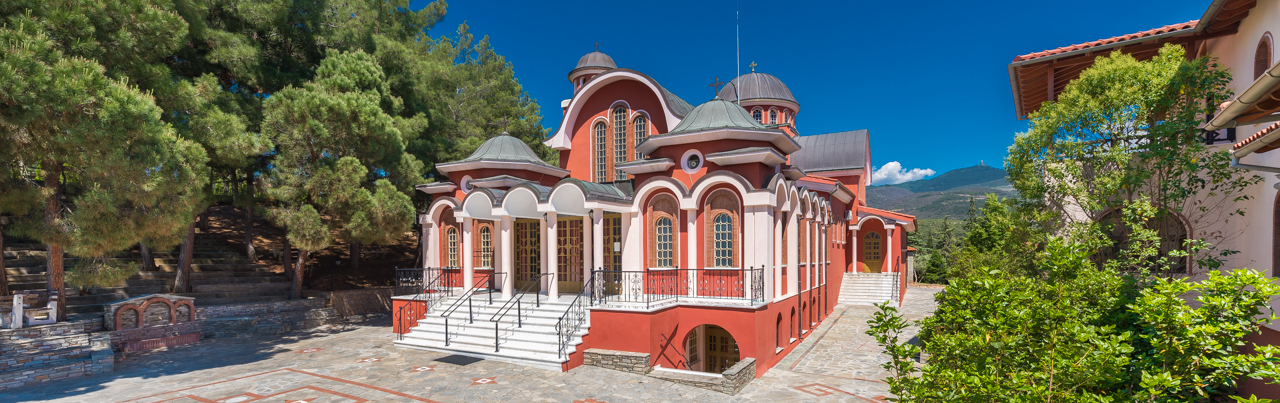
History of the Monastery
The founder and builder of the male hesychasterion (monastic hermitage) “The Holy Trinity” is Father Symeon Kragiopoulos (†2015). He was born in 1926 in Rytini, Pieria, studied at the Theological School of the Aristotle University of Thessaloniki, and was ordained a cleric of the Holy Metropolis of Thessaloniki in 1954. He continued the work of his spiritual father, Timotheos Papamichael, in the brotherhood “The School of Christ.” He served as a preacher and parish priest of the metropolis in various churches in Thessaloniki.
After completing twenty years of spiritual ministry, he sought a quieter, hesychastic place of residence. His original intention was simply to find a plot of land on which he could build a small house in which to live, away from the noise of the city. On the Day of the Holy Spirit, he found the plot of land in Panorama where today’s hesychasterion is located. Initially, he built four cells and stayed there with some of his associates. Gradually, he added more cells and established an internal church in honor of the Annunciation of the Theotokos.
For the needs of the faithful, a slightly larger small church (naidrion) was formed in honor of the three Holy Theologians: John the Evangelist, Gregory the Theologian, and Symeon the New Theologian. The feast was established with the blessing of Metropolitan Panteleimon II. Father Gerasimos Mikragiannanitis composed a complete liturgical service (akolouthia), and their memory is celebrated jointly on the first Saturday of November as the second feast day of the hesychasterion.
The entire work of the hesychasterion is closely connected to the Holy Trinity. The most significant events of the foundation of the hermitage were linked to the Feast of the Holy Spirit, without being planned in advance. In 1947, Father Timotheos had established the Feast of Pentecost as the patronal feast of the original spiritual group. On the Feast of Pentecost in 1974, the first Divine Liturgy was celebrated in the original building. On the Day of the Holy Spirit in 1976, the foundation stone of the Church of the Holy Trinity was laid, and again on the Feast of Pentecost, the first Liturgy was celebrated.
Father Timotheos fell asleep in the Lord and was buried in Lyon in 1954, where he had gone for postgraduate studies on the works of Saint Symeon the New Theologian in the autumn of 1953. Twenty-three years later, during the week of the Holy Spirit in 1977, the reburial of his relics took place, which Father Symeon transferred under difficult conditions. An annual memorial service was established on the day of his repose, and his writings and speeches related to his life and spiritual work were published, such as the book Father Timotheos Papamichael.
Father Symeon based his spiritual work on the spiritual legacy of Father Timotheos and on the spirit of the teaching of Saint Symeon the New Theologian, a spirit into which Father Timotheos himself had first been initiated. Father Timotheos, with his faith, humility, and discernment, led Father Symeon to the path of Christ and initiated him into obedience to Christ and the Church. Saint Symeon, through his life and ascetic works, inspired the spiritual life and teaching of Father Symeon. In the person of Saint Symeon, he found all of patristic theology gathered, and through his intercessions, he established the two hesychasteria in Panorama.
In the 1980s, several young men gathered near Father Symeon, wishing to study under his guidance in a spirit of obedience and to follow his spiritual life. They followed a monastic schedule according to the standard monastic typikon, waking up in the morning around 4:00 a.m. for the Midnight Office (Mesonyktikon), Matins (Orthros), and the Divine Liturgy. They shared a common meal (trapeza) early in the morning, and after the hours of their obediences (diakonemata), they performed the service of Vespers, the evening meal, and Compline (Apodeipno).
Because some young women also wished to live a similar monastic life, Father Symeon formed the women’s sisterhood under his spiritual guidance in 1987. Thus, the hesychasterion “The Nativity of the Theotokos” was founded and officially recognized by the Church of Greece in 1993. Eldress (Gerontissa) Philothei was elected as the Abbess of the hesychasterion. Her enthronement was performed by Metropolitan Panteleimon II of Thessaloniki. The consecration of the Church of Panagia Kecharitomene (Full of Grace) took place in 2005 by His Holiness Metropolitan Anthimos. The opening of the doors (thyranoxia) of the Katholikon (main church), which honors the Nativity of the Theotokos, was performed by the same Metropolitan in 2012.
In the men’s hesychasterion, the consecration of the Church of the Holy Trinity was likewise performed by Metropolitan Anthimos in 2009, as was the official recognition of the hesychasterion “The Holy Trinity” in 2014, one year before the repose of Father Symeon. The founder and first abbot of the hesychasterion fell asleep in the Lord on September 30, 2015. His grave is located opposite the Katholikon of the Holy Trinity. In addition to the customary memorial service on the day of his repose, a founder’s memorial service is held on the afternoon of the patronal feast, on the Monday of the Holy Spirit.
Archimandrite Father Ioannis Grintzos was elected as the new abbot of the holy hesychasterion. His enthronement was performed by Metropolitan Anthimos on November 30, 2016. With the prayers of Father Symeon, the monastic schedule continues as established by the blessed father, and his words are disseminated through books and the new website, enlightening many believers. Continuous cycles of forty-day liturgies (sarantaleitourga) are celebrated without interruption, as established by Father Symeon from the early years of the foundation of the hesychasterion. On all major feasts, small vigils are held, except on Saturdays and Sundays, when morning Liturgies take place. According to the instructions of Fr. Symeon, the principal work of the brethren is first and foremost to live the monastic life and, as spiritual fathers, to offer spiritual rest to those who approach them through confession.